Esqube Industries LLC, a leading plastic products supplier and manufacturer in the UAE and India, specializes in innovative plastic solutions. The company ventured into the injection molding technique during the 21... ReadMore
Esqube Industries LLC, a leading plastic products supplier and manufacturer in the UAE and India, specializes in innovative plastic solutions. The company ventured into the injection molding technique during the 21... ReadMore


Through this blog, we shall explore how there has been a revolutionary change in the way seafood is transported, from using traditional fish boxes that are usually made of wood and metal to plastic fish crates. This blog shall be helpful for those who are into fish processing, distribution, cold chain logistics, and procurement.
• Plastic fish crates have more advantages than wooden or metallic crates from a perspective of hygiene, durability, and efficiency.
• The fishing industry increasingly demands that only boxes impervious to contamination and easily sanitized be used.
• Fish crates built with HDPE material can resist salt water, ice, and bacteria.
• Selecting plastic crate suppliers in the UAE will ensure that institutions can easily obtain high-quality boxes suitable for the cold and heat chain.
• Using plastic fish boxes will be cost-effective relative to using the conventional boxes.
Forward-thinking companies have decided to switch from wood to plastic fish crates, as they are not only hygienic, durable, and economical but also much better adapted to the harsh conditions of seafood production and transportation. Actually, plastic fish crates are the best choice when hygiene, efficiency, and long-term cost-effectiveness are at stake. They are definitely not ordinary storage containers; they are highly specialized solutions developed especially for a very challenging industry.
If you need a quality manufacturer of premium plastic products for industrial purposes, then you can count on Esqube. Our crates will surely match all your needs and expectations.
A simple explanation: they just cannot keep up. Wood crates soak up moisture, are riddled with bacteria, and easily deteriorate under damp conditions. Metal cases rust, are heavy, and are impossible to clean effectively for each new shipment. Food safety regulations are becoming more stringent around the world, and any business that fails to comply is liable for steep fines or, worse, for distributing unsafe produce.
In the year 2026, it is the perfect time for such a change due to regulatory constraints, consumer demands, and better logistics. The convergence of all of these factors in one time period explains the timing of the industry's decision to move forward with this change.
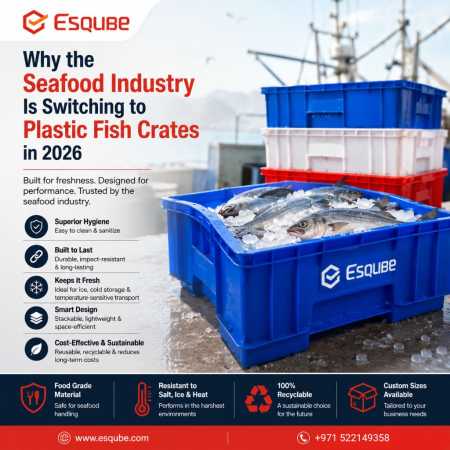
Plastic fish crates designed specifically for this purpose offer several benefits that no other materials can provide:
• Hygiene: Does not have any holes, making cleaning a relatively easy task.
• Corrosion resistance: Resistant to chemicals and saltwater, thus it can be used in areas characterized by harsh environments during the processing of seafood.
• Weight: Lightweight, but at the same time tough.
• Packaging: The design makes it possible to stack safely for storage and transport while frozen.
• Durable: With proper maintenance, one good-quality industrial plastic crate can last 8 to 15 years, while wooden crates may last only 1 to 2 years.
Absolutely, and more often than not, they are even more effective. These designs ensure that maximum ice storage is achieved with minimal melting rates. The tubs are made of plastic, as opposed to other designs such as wooden or styrofoam tubs that easily absorb water and smells.
This ensures that the tubs remain fresh and ready for use. Several companies have also witnessed improvement in effectiveness by having lower levels of spoilage rates after using plastic containers. Spoilage rates are extremely significant in determining profitability, especially for those companies handling large amounts of goods daily.
There are several factors influencing the quality of plastic fish crates, one of which is the production process of this container. Trustworthy companies manufacture crates made of injection-molded or roto-molded plastic using only high-quality food-grade HDPE or polypropylene. The following procedures occur:
• Selection of raw materials: Use of raw materials that do not have any toxic elements.
• Design of the mold: To ensure uniformity of wall thickness as well as perfection of loading.
• Tests: Tests to ensure load-bearing capacity, ultraviolet resistance, and safety from falling.
• Compliance testing: To comply with international standards for food legislation, such as ISO and HACCP.
If you decide to purchase your crates from a reputable plastic product manufacturing company, then you will get a crate that was designed specifically for its intended purpose.
The UAE is now considered a crucial supplier of seafood containers and packaging for several reasons. Some of the benefits offered by a plastic crate supplier in the UAE include:
• Closeness to the main seafood consumers in the GCC, South Asia, and East Africa.
• Production methods compatible with international food safety laws.
• Tailored sizes that will accommodate certain kinds of fish based on size and weight.
• Price efficiency owing to advanced production methods.
• Lead times appropriate for fresh fish shipments.
In addition, a UAE supplier makes logistics easier in case of imports.
The switch from wooden crates and boxes to plastic is not just a new trend in the seafood industry; it is an inevitable evolution. Given the food safety issues, sustainable approaches, and simple business logic, firms from around the globe have decided to make this move into the more contemporary approach to seafood logistics.
For any business willing to leap success, there is one company in particular that can help you achieve that goal: Esqube. As a proven leader in the supply of plastic crates in the UAE and in the manufacturing of quality industrial plastic crates, Esqube provides customized solutions that ensure your success.
Plastic fish boxes can last for 8 to 15 years – significantly longer than wood or metal substitutes.
The answer is yes since they are made from food-safe HDPE plastic material.
Most trusted manufacturers, including those located in the UAE, can provide you with customized fish boxes.
Yes, fish boxes made from HDPE and polypropylene can be recycled.
It is important to make sure that the product meets the standards of ISO and HACCP.